

As published in the Expert Witness Journal, July/August 2026.
Introduction
Before I begin this article, I think it is only right to explain that this is not about true-value claims, in which my quantum friends set out to determine the genuine final valuation of the work done. This article is about Value Engineering (VE).
What is Meant By Value Engineering?
Value engineering was first developed in the USA during World War II and in its aftermath, when there were shortages of both skilled labour and materials. As a result of these shortages, manufacturers looked for acceptable alternatives. It was discovered that the alternatives often led to reduced costs, improved the product, or both.
In construction projects, most are familiar with the process of one party suggesting alternative materials or design changes, which the team will consider and may implement. Some ideas may be adopted and others discarded. The idea being that, where these VE suggestions are adopted, they will save time and/or money without compromising quality or function.
It is often the case that the individual suggestions are made by the contractor as part of its tender submission or during the lead-in period following the award of the contract. Or it may be an exercise which is instigated by the Employer. Engineering solutions will have been considered when the design was first developed; however, VE can be carried out in more detail once the contractor is involved, as it has access to a wider specialist supply chain and its own practical experience.
VE is not a cost-cutting exercise that relies on reducing scope or omitting items to cut costs, nor is it about downgrading the specification below the level of performance set by the design team and the Employer. The exercise seeks to reduce costs while delivering the same or better function or performance.
The Best Time For Value Engineering
VE can take place throughout the project design and construction period. The benefit of the VE exercise is likely to lessen as the project progresses. Figure 1 illustrates the pattern of decreasing impact and increasing cost as the project increases1.
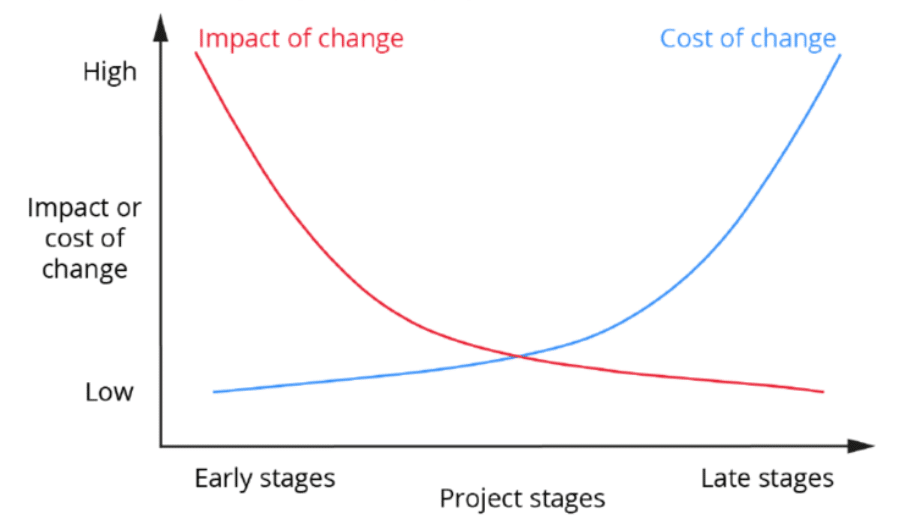
Figure 1
Introducing value engineering early in the process should lead to efficiencies in the project delivery and cost benefits to all. Well, that might be the theory, but it is not always the reality.
What is The Reality?
First, I will provide the caveat that my day job is working on distressed projects. I appreciate that there are many projects that run very smoothly and are delivered on time and on budget. I know this because my previous day job was a contractor’s project manager.
Back to my current day job. I have seen many examples in which VE exercises did not develop as intended. Actually, when I use the word ‘seen’, I actually mean ‘heard of’, that is because often the only available ‘records’ are in fact people’s recollection of what happened.
Yes, there may be an obvious change from one drawing revision to the next. But what instigated that change? The drawing is often (but not always) issued under the cover of an Architect’s Instruction (AI), meaning the change appears to be an Employer change, especially since the only record is the AI that introduced the revision. Then, when the project is delayed, well, you can imagine.
All too often, as I set out to investigate the cause of a project delay, the evidence indicates that the delay was due to late design information. The designer will often state that the late design was due to the contractor’s VE exercise, which then involved a complete redesign of ‘abc’, and all parties were aware of this and agreed to it at the time.
‘Records, Records, Records’
Many of you will be familiar with the expression ‘Records, Records, Records’. This mantra also applies to VE exercises.
It is true to say that there will almost certainly be a record of some sort of change in price, however, the basics are often missing, including:
- What? What was the change?
- Who? Who instigated the change?
- Effect? What was the expected effect in terms of time (programme) and money?
- Outcome? Were the proposed VE items implemented or declined?
The Irony
The purpose of the VE exercise is usually to save money or time or both2, so it is ironic that the same VE items are often the cause of project delays and, therefore, additional costs.
There can be many reasons for this; it depends largely on the specific circumstances, but below are some real-life examples from disputes I have been involved in.
Case study 1
The project was a large steel-framed development constructed off a reinforced concrete (RC) slab, which in turn was supported by concrete piles. The contractor suggested that changing from the intended RC slab to individual pile caps would result in programme and therefore cost savings.
The rationale being that the pile caps could commence sooner, as unlike the RC slab they did not require all the piling to be completed first. In turn, this meant the steel frame erection could commence sooner, and once the first-floor metal deck was installed, the revised ground-floor RC slab could proceed.
This all sounds reasonable and not controversial. However, timing was the key – remember Figure 1? The proposed VE change and its acceptance came very close to the start of on-site works, and, of course, the foundations were among the first activities to be constructed and were on the programme critical path. The second key point was that the structural engineer now needed to completely redesign the foundations.
What went wrong?
- There was no documentary record of the VE exercise.
- The redesign required the engineering resources to be taken from other design work.
- The revised drawings and schedules were ‘late’ in being issued compared to the original baseline programme.
- Moving design resources caused delays to other elements of the building.
With the foundation design delayed, the contractor submitted a claim for additional time and money.
Based on the documentary evidence, the foundation design was indeed late and caused a delay to the critical path works. Unfortunately, there were no records demonstrating how the design change came about, nor of the ‘agreement’ to issue the design in phases in accordance with a timetable provided by the contractor.
Ironically, rather than save time and money, the VE item did the opposite.
Case study 2
A speculative development consisted of a steel-framed building wrapped in a mixture of cladding and curtain walling – nothing remarkable. However, the main entrance area featured a heritage brick feature wall to tie it to the existing Victorian building next door.
As part of a VE exercise, the contractor suggested there could be savings if a modern steel-framing system (SFS) with brick slips were used instead of a brick wall. “Excellent”, the design team said, and off they all went.
However, over the several months that followed, the contractor presented multiple samples of the available brick slips and even constructed several sample panels, all to no avail. The reason being the available brick slips just did not come close to matching the existing Victorian brickwork next door.
Fortunately, the building of the wall in question was not on the programme critical path; therefore, there was no delay to the completion date, but it did cause disruption and certainly increased costs rather than providing savings.
What is the Answer?
The obvious point is to ensure everything is recorded – who instigated the VE exercise or suggestion. What was agreed, including the timings for the provision of information, sign-off, and so on.
Consider whether it might be appropriate to have a cut-off point. In the case of the brick slips, should the team have called it a day and reverted to the original design? A lot of time was spent sourcing and reviewing the various options, so factor this into the management process.
Where several VE items are introduced and implemented – usually at the pre-start of work or very early in the project, I would suggest taking the time to revise the programme to fully reflect the changes. Include any agreed design release dates. Demonstrate that the VE change will save time or, at a minimum, not increase time or delay project completion. This might sound like the most obvious point, however, I find it surprising how often it does not happen, and the entire team proceed on the basis of the original programme.
Case study 3
This example was a speculative office development in a city centre location. As work progressed, the developer had several different design ideas. Some were unusual, some complex, some were simply aesthetic. One idea that did not fall away was a conference room with glass walls, several levels up in the building, cantilevered out over the central atrium.
This is slightly different and does not immediately stand out as value engineering, although to the developer it was considered to increase the overall value of the development; therefore, in that sense, it could be said to be VE.
The team made the bold move to temporarily suspend all on-site work. The design team went away and reworked the entire design to incorporate the conference room and a few other ideas. Once complete, the contractor priced the revisions as part of a Variation Order. Part of this included reprogramming the works.
Everything agreed, work recommenced.
Unfortunately, the project delivery did not proceed as planned, and the handover was significantly delayed. The contractor faced difficulty demonstrating entitlement to any further extension of time because the works had been reprogrammed based on the revised design, and subsequently, little had changed. If the team had not made the bold move to suspend and reset the programme, the contractor might well have blamed the entire delay on the initial changes.
And Finally
Value engineering can benefit everyone. It can provide an equal or better product and bring cost or time savings or both. For it to be truly successful, the whole process needs to be properly managed by all the parties.
Ensure the programme is updated to fully reflect the VE items, not just the work content, but also the design development. Include agreed release dates. Transparency is key.
And remember the old saying, ‘Records, Records, Records’!
About the Author
David Waddle DipICArb FCIOB FAPM MCIArb AMICE is a Regional Director and Construction Expert Witness based in the United Kingdom. David has more than 40 years of civil and building experience working on major UK projects both as a site-based planner and project manager, and as a delay and construction management consultant.
References
- RICS Practice Information ‘Value management and value engineering’, 1st Edition, January 2017. ↩︎
- It can also be that the VE exercise is instigated to find an improved end product; however, for the purpose of this article, the focus is on money and time. ↩︎
This article is intended to provide general information and insights into prevailing industry practices. It is not intended to constitute, and should not be relied upon as, legal, technical, or professional advice. The content does not replace consultation with a qualified expert or professional regarding the specific facts and circumstances of any particular matter.