

Overview
Parking garages are an often-overlooked part of a building’s infrastructure, but they bear the weight of vehicles, endure exposure to the elements during freeze and thaw cycles, and experience constant traffic-related wear and tear. Over time, these factors can lead to serious structural deterioration if not properly monitored.
Periodic parking garage inspections are more than just a regulatory requirement; they are a fundamental part of maintaining public safety, extending the life of a structure, and minimizing costly emergency repairs. To building owners, parking garages are a significant revenue generator, and any delays or closures can significantly impact future earnings. To help mitigate loss of revenue and costly repairs, it’s valuable to understand what’s beneath the surface and get ahead of any systematic failures. At the forefront of our inspection process is the use of ground-penetrating radar (GPR), a powerful, non-invasive technology that enhances the quality, accuracy, and efficiency of our findings.
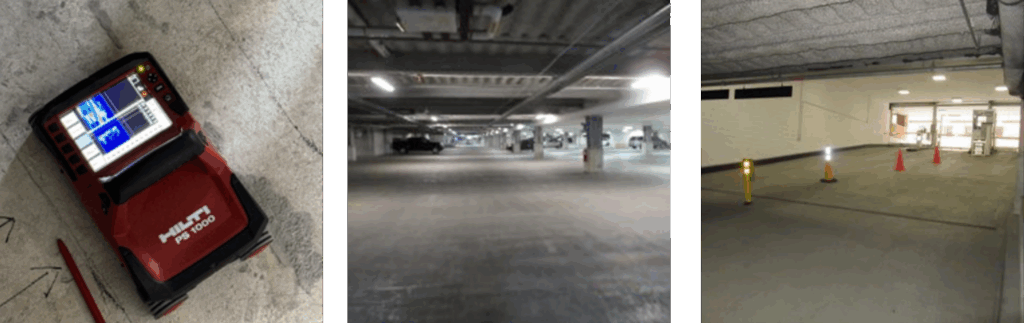
Understanding the Importance of GPR
GPR is a non-destructive testing method that uses high-frequency radio waves to scan concrete surfaces. When these waves encounter a boundary between materials (like steel rebar, voids, or cracks), they bounce back to the scanner, allowing us to create a detailed image of what’s beneath the surface.
One of the greatest benefits of GPR is that it allows us to “see” inside concrete without the need to drill or damage the structure. This is particularly important in active garages, where disrupting daily operations or weakening a structure is not an option. Using GPR, we can detect reinforcement layout and spacing (e.g., rebar and post-tension cables), concrete thickness, delamination, voids, potential water intrusion zones, and areas of corrosion or deterioration before they become visible.
This level of insight helps ensure that our inspection reports are not only compliant but comprehensive, helping property owners make informed decisions about repairs or preventive maintenance.
Traditional methods of structural assessment can be time-consuming and costly, often requiring probes. GPR speeds up the inspection process and reduces labor costs while minimizing disruption to parking operations.
Another extremely useful instance of utilizing a GPR scanner is during the construction and testing phases. The scanner provides the information needed for a contractor to perform probes and/or core samples through a concrete deck or membrane. This tool is critical in aiding the contractor from damaging structural reinforcement. Rimkus is often contracted to inspect after the structural components have been cut, chipped, or damaged. If you allow us to assist during these phases, we can often help you avoid costly mistakes and headaches.
At Rimkus, we integrate GPR technology into our parking garage inspections. It enhances the quality of our work, reduces risk for our clients, and helps ensure compliance with rigorous safety standards. Whether you’re preparing for your first inspection cycle or planning proactive maintenance, GPR helps deliver reliable, accurate, and efficient results.
Need an inspection or consultation?
Contact us today to learn more about our GPR-enhanced parking garage assessments and how we can help you stay compliant with local ordinances.
Tom Khoudary
[email protected]
+1 862-282-3812
Jimmy Monahan, P.E. QPSI, QRWI
[email protected]
+1 862-686-4833
About the Author
For information about our Building Advisory Services:
Disclaimer
This article aims to offer insights into the prevailing industry practices. Nonetheless, it should not be construed as legal or professional advice in any form.