

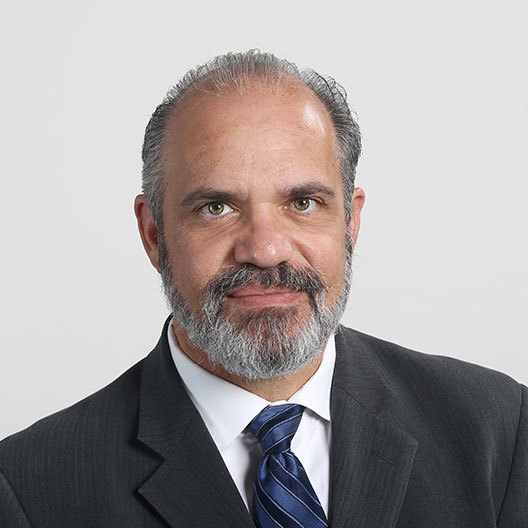
Richard V. Baratta, Ph.D., P.E.
Senior Vice President, Biomechanical Practice
SERVICES GROUP
LOCATION
Get to know the expert
Expert QuestionS & AnswerS
Biomechanical engineering often sits at the intersection of medicine and physics — how do you explain complex injury mechanics in a way that juries and attorneys can easily understand?
This is the most important task that a biomechanical engineer has in the courtroom — to explain fairly complex concepts in a way that is distilled down to common sense. It is important to explain in terms that are approachable, but that remain technically appropriate — especially since some concepts may be counterintuitive.
As an expert witness, what’s the one thing you wish judges and juries better understood about biomechanical engineering?
That we’re trained in anatomy, physiology, and engineering. We don’t diagnose injuries, but we do understand the mechanical implications, so we essentially translate a medical diagnosis into a mechanical failure of human tissues. The other thing I’d want people to understand is that how our work focuses on more than just how much force it takes to cause an injury. In reality, the more important question is usually about the type of force, and whether the right kinds of forces were present to produce a specific injury. That distinction matters enormously in how we interpret the evidence.
Background
Dr. Richard Baratta holds a B.S. degree in Biomedical Engineering and Mathematics and an M.S. and Ph.D. in Biomedical Engineering.
Dr. Baratta’s experience has included multiple aspects of orthopedic, facial, and spinal biomechanics and rehabilitative engineering and research. He has an extensive publication record addressing basic, applied, and clinical orthopedic topics, and has performed collaborative research with other intramural departments and outside academic and industrial institutions. He has experience in the development, clinical implementation, and writing of FDA submissions for a paraplegic ambulation device. Dr. Baratta taught biomechanics to orthopedic surgeons seeking recertification.
His primary areas of consulting expertise include injury consistency biomechanics, accident reconstruction, medical device failures, and intellectual property. As a forensic investigator, Dr. Baratta performs biomechanical analyses on cases involving low-speed accidents, driver determination, falling objects, slip and falls, amusement rides, and other accidental events. He has reconstructed accidents involving low-speed accidents, high-speed fatality collisions, pedestrian accidents, vehicle rollovers, and other types of accidents.
Dr. Baratta also provides expertise in relation to modified, high-performance, and racing automobiles, and high-performance vehicle occupant protection systems and injury analysis. Dr. Baratta is fluent in English and Spanish and has testified in both depositions and trials in the U.S. and Mexico.
Education and Certifications
- Biomedical Engineering, Ph.D.: Tulane University (1989)
- Biomedical Engineering, M.S.: Tulane University (1986)
- Biomedical Engineering and Mathematics, B.S.: Tulane University, Magna Cum Laude (1984)
- Certified Accident Reconstructionist: Accreditation Commission for Traffic Accident Reconstruction (ACTAR #1683)
- Bosch Certified Crash Data Retrieval Technician and Analyst
- Registered Professional Engineer: Texas (#100978), Florida (#70049), Louisiana (#34792), Illinois (#062.061946), Alabama (#30609-E), New York (#087619), Indiana (#10911206), Georgia (#037772), Oklahoma (#26386), Colorado (#47906), and Mississippi (#20899)
Contact Information
Testimony Experience
- Arbitrations
- Depositions
- Hearings
- Trials