

Cost estimating is essential in the insurance industry, where accurate, transparent, and defensible cost predictions underpin reliable reinstatement assessments and claim evaluations. By combining a defined scope, trusted data, and a structured use of contingencies and probabilistic accuracy ranges, estimators can help insurers allocate appropriate funds, avoid surprises, and maintain financial stability throughout the claim’s lifecycle. As the project definition matures, estimate accuracy improves, enabling insurers to benchmark third‑party figures, validate repair scopes, and ensure that submitted costs truly reflect the required reinstatement.
In complex scenarios—especially brownfield insurance claims involving constrained access, live facilities, or degraded environments—productivity factors and execution challenges significantly influence cost outcomes. Skilled estimators bring technical knowledge, risk awareness, and consistent methodology to produce realistic, defensible figures. This robust estimating process supports insurers in making informed decisions, preventing under‑ or over‑funding, and delivering timely, predictable claim resolutions.
What is Cost Estimating?
Cost estimating is the process of analysing a specific scope of work and predicting the cost of performing that work with a certain level of accuracy. It involves collecting, analysing, and summarising all available data related to a project. The resulting cost estimate is crucial for supporting project and repair activities. It aids in:
- Decision-making,
- Budget preparation and submission,
- Economic evaluation,
- CAPEX project financing,
- Portfolio business activities,
- Benchmarking,
- Managing expectations after budget submission.
Additionally, cost estimating supports appropriate funding allocation and understanding the company’s financial standing, priorities, resource needs, and the strategic value of projects.
Cost Estimate Application
Cost estimating is applicable across various industries and project types. Including, but not limited to:
- Process Plants: Including petrochemical and refineries, LNG, LPG, gas storage, compressor stations, tank farms, and gas trains.
- Fixed and Floating Facilities: Such as CPF, FPSO, TLP, and semi-submersibles.
- Energy Transition Projects: Covering renewable energy sources and related infrastructure.
- Offshore Platforms: Including process and drilling platforms, wellheads, utility platforms, pipelines, and subsea systems.
- Power Generation: Encompassing various types of power plants and energy production facilities.
- Infrastructure Projects: Such as buildings, rail systems, and nuclear facilities.
Cost-estimating principles remain consistent across different types of businesses and projects, whether greenfield (new projects) or brownfield (existing projects). The approach to cost estimating is universal, ensuring accurate and reliable estimates.
Cost Estimate Components
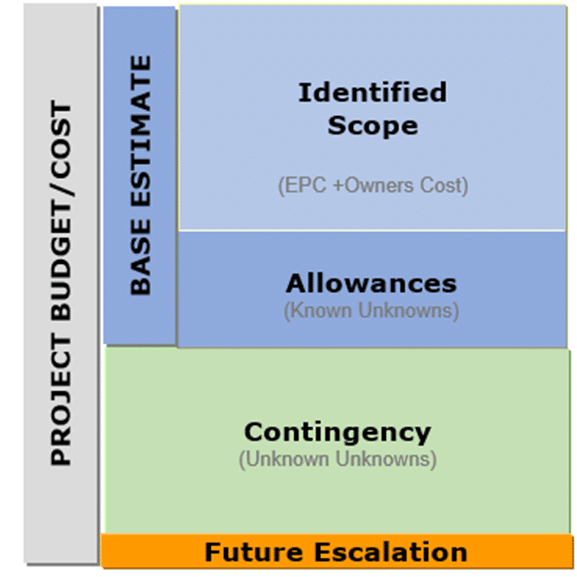
Typical project cost estimate components include several key elements that ensure a comprehensive and accurate estimate of project costs. The main components of which are:
The Base estimate, which consists of the identified scope and allowances.
Identified Scope: This includes the Engineering, Procurement, and Construction (EPC) costs, along with the owner’s costs.
Allowances (Known Unknowns): These are amounts included in the project estimate for specific elements that cannot be fully specified at the time, such as technical, procurement, and weather allowances.
Contingency (Unknown Unknowns): This is the amount of money added to the project base estimate to account for uncertain events and risks, excluding major scope changes and “Force Majeure” events.
Future Escalation: This accounts for changes in price levels due to market conditions and price drivers, including inflation.
Project Budget/Cost: This is the total cost, including the base estimate, contingency, and future escalation.
Figure 1 – Project Cost Estimate Components
Cost Estimate Components Maturity Evolution
The maturity evolution of cost estimate components progresses through various stages of project definition, as shown in Figure 2. Each stage involves different levels of detail and accuracy in the cost estimate components:
Figure 2 – Cost Estimate Maturity Evolution
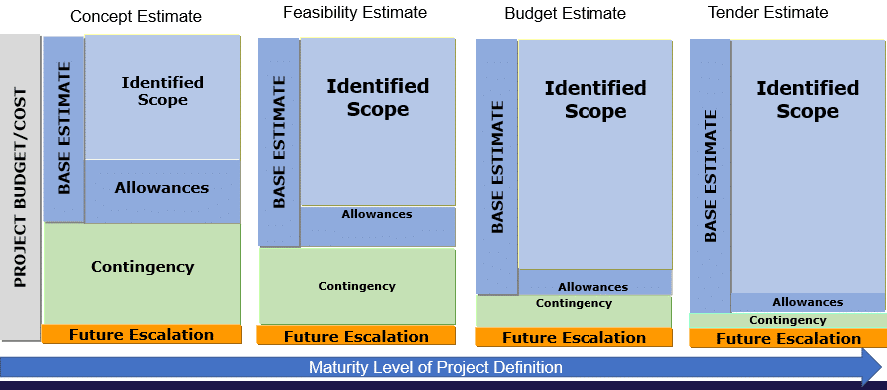
The estimate improves as more information becomes available or becomes more defined, reducing the level of unknowns reported in previous phases and minimising risks and uncertainties in executing the projects and in assessing damages/repairs.
Cost Estimate Classification System
There are numerous characteristics that can be used to categorise cost estimate types. The most significant of these are the maturity level of project definition deliverables, end usage of the estimate, estimating methodology, and the effort and time needed to prepare the estimate. The primary characteristic used in this guideline to define the classification category is the maturity level of project definition deliverables. The other characteristics are secondary. Categorising cost estimates by the maturity level of project definition is in keeping with the AACE1 International philosophy of total cost management, which is a quality-driven process applied during the entire project life cycle. The discrete levels of project definition used for classifying estimates correspond to typical phases and gates of evaluation, authorisation, and end execution, often used by project stakeholders during a project life cycle
Table 1 – Cost Estimate Classification System
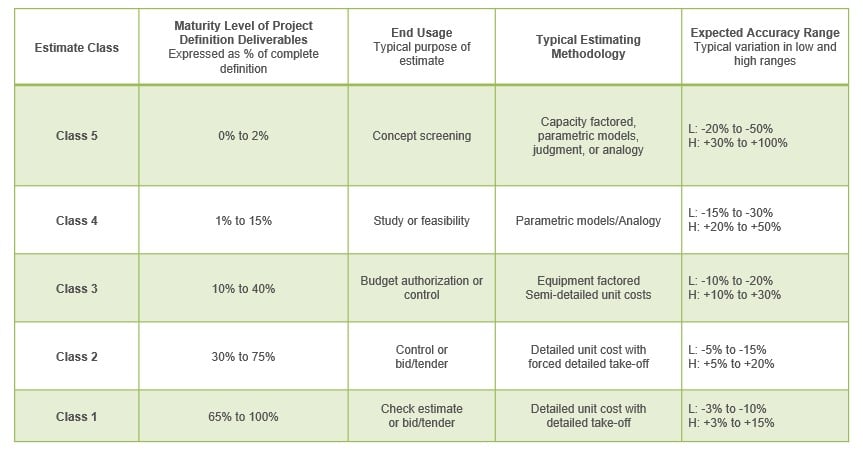
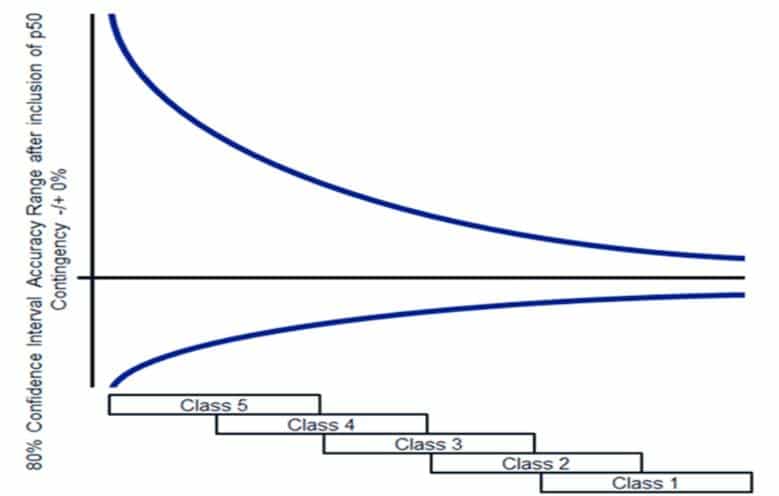
The more the level of project definition increases, the narrower the accuracy range becomes, as shown in Figure 3:
Figure 3 – Accuracy Range
Accuracy Range – Definition
The Estimate Accuracy Range is an indication of the degree to which the final cost outcome for a given project will vary from the estimated cost. Accuracy is traditionally expressed as a +/- percentage range around the point estimate after applying contingency (P50), with a stated level of confidence that the actual cost outcome would fall within this range (+/- measures are a useful simplification). The accuracy values are referred to as P10 and P90 of a Gaussian distribution. The accuracy of the estimate is a function of both how well the specific scope of the estimate is defined and the time and information available to the estimator. See the figure below (Figure 5) showing where the expected cost (P50) is located within the cumulative Gaussian distribution.
Figure 4 – Accuracy Definition as Cumulative Gaussian Distribution
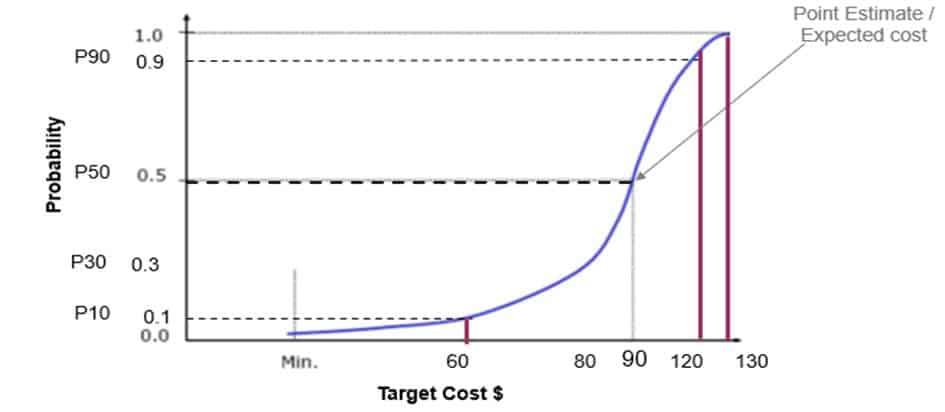
The upper and lower boundaries of the accuracy range are defined as having a probability of less than 10% of overrun and underrun (P10 & P90), respectively. This represents an 80% cost estimate level of confidence. The figure below (Figure 5) shows the process that defines the accuracy range and the contingency applied to the base cost to derive the P50 value (Expected Cost).
Figure 5 – Expected Cost (P50)
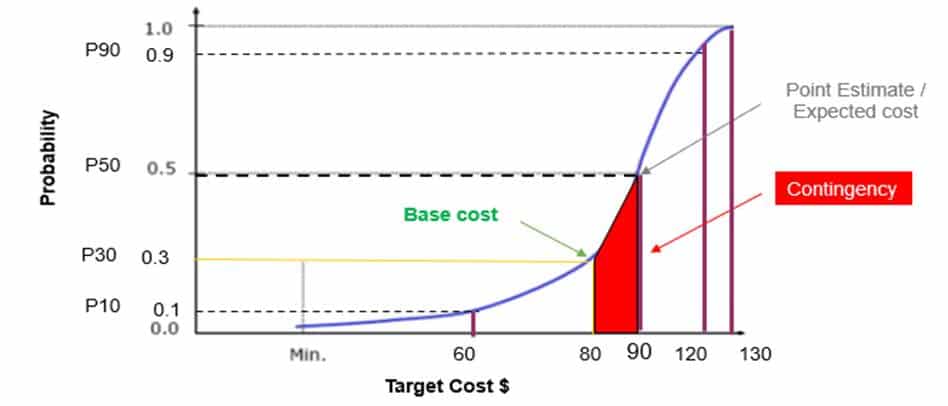
This cost curve distribution is derived from a Montecarlo probabilistic analysis, which is the mathematical way of explaining the accuracy range. If we take the above distribution curve as a case study, the results of the Montecarlo analysis show the following:
- Base cost: The initial cost estimate before any contingencies are added. In this case, it is $80.
- P10: Defined as having a probability less than 10% to underrun the project budget, resulting in a cost value of 60$.
- P30: Probability of 30% occurrence related to the base cost.
- Contingency: Amount added to the base cost to achieve the expected cost (P50), resulting in a cost value of $90.
- P50: Probability of 50% to meet the expected cost.
- P90: Probability of 90% occurrence to not exceed the project budget, resulting in a cost value of 120$.
- Accuracy Range: This represents the potential variation in the cost estimate. The lower boundary is calculated as (P10 – P50) / P50, and the upper boundary is calculated as (P90 – P50) / P50. These boundaries help in understanding the range within which the actual cost is expected to fall. This range is defined to ensure that there is less than a 10% probability of the cost exceeding the upper boundary (P90) or falling below the lower boundary (P10). This provides an 80% confidence level in the cost estimate.
For budget submissions, operators may choose different probability levels (P50, P70) based on their risk tolerance. Some operators prefer to submit the budget at P70 to be on the safe side, depending on whether they are risk-prone or risk-averse. Submitting the budget at P70 offers more certainty but may limit resources for other projects. Most organisations work in a way that they approve the project at P50 and re-authorise the budget only if the cost outcome exceeds the upper boundary of the estimate. For instance, if a project is approved with a $100 budget and a +/-10% accuracy range, it won’t require re-authorisation unless the cost exceeds $110. This allows for flexibility in managing project costs without frequent re-approvals.
Greenfield Vs Brownfield
Greenfield projects are new initiatives that start from scratch, involving the construction of brand-new facilities in a new area. In contrast, brownfield projects are works carried out within the boundaries of an existing facility. Brownfield work typically involves significant interfaces with existing facilities and, quite often, these facilities are operating while the new work progresses. Expansion projects, revamp projects, yield improvement projects, repair projects, and reinstatement projects fall under the category of brownfield projects. Demolition works, removal of debris, and wreck disposal are also considered brownfield projects but are often overlooked. The main differences between greenfield and brownfield projects are that brownfield work is performed in confined areas, which are difficult to access, possibly in live operating plant environments, and requires skilled personnel. Labour productivity is significantly impacted in brownfield projects, playing a key role in overall project execution. More man-hours, more time, and more cost are typically associated with brownfield projects.
The Productivity Factor (PF) is commonly defined by estimators as the labour hours required to be expended to do one hour of work based on standard production benchmarks, such as US Gulf Coast Labour Production Rates. For example, a productivity factor of 3 in a brownfield plant in Egypt represents an increase in hours (by 3) required to produce the same amount of work as one hour in the US Gulf Coast. Essentially, one hour of work in the US Gulf Coast is equivalent to three hours in Egypt.
Productivity Factor Contributors
Several contributors impact job site productivity, including the following:
- workforce experience,
- skill, and age,
- labour availability,
- job size and complexity,
- scheduled overtime, double shifts, and shutdowns,
- craft labour manpower density,
- accessibility to the job site,
- availability of laydown and staging areas,
- plant equipment availability and utilisation,
- labour relations and contractual agreements,
- local climatic conditions and local political stability,
- local work rules and cultural characteristics.
Among these factors, those highlighted in bold are particularly important for brownfield projects.
The Role of the Cost Estimator in the Insurance World
The role of a Cost Estimator is crucial in predicting, with a reasonable degree of certainty, the final cost of a planned scope of work to be completed at a specific location and point in time. However, it is important to recognise that a cost estimate is inherently a prediction and, therefore, carries some level of uncertainty. To minimise this uncertainty, it is essential that the cost estimate is accurate and based on the most up-to-date information and cost data available.
A proficient cost estimator must have a thorough understanding of the project/repair scope, including its boundaries and execution strategy. They should also be well-versed in the concepts of risk and risk management processes, as well as the fundamentals of developing and documenting a cost estimate and scope damage assessment correctly. When information is lacking, the estimator should make reasonable assumptions to produce a realistic estimate.
Additionally, the estimator must clearly state the “accuracy range” (expressed as a percentage) to indicate the degree of confidence in the final cost outcome. This accuracy range provides a measure of how likely the actual cost will fall within the estimated range. It is important to note that every cost estimate inherently comes with a range, reflecting the inherent uncertainty in predicting future costs.
Skills and Knowledge of a Cost Estimator
Cost estimators must understand various elements of cost, including direct and indirect costs, cost classifications, and cost types. They should also be proficient in analysis techniques such as statistics, economic and financial analysis, optimisation, and physical measurements. Essential knowledge areas include enterprise in society, people in organisations, information management, quality management, value management, and environment, health, safety, and security (EHS).
Estimators must be adept at planning the estimate, applying methodologies, quantifying scope and cost, pricing, conditioning the estimate, evaluating risk, documenting the estimate, and performing estimate reconciliation, review, validation, reporting, and closeout.
As is evident from the above, effective cost estimating requires a comprehensive understanding of various skills and knowledge areas. By mastering these competencies, cost estimators can provide accurate and reliable estimates, supporting successful project outcomes.
Key Elements in Developing an Estimate
When developing a cost estimate, an estimator must ensure that several key elements are in place to support the successful output of the cost estimating process. Firstly, it is crucial that reference data are relevant and correct, and that source cost data are reliable and up to date. Project-specific factors must be applied consistently throughout the estimating process. Additionally, the basis, assumptions, plan, strategy, and development outputs must be well-documented in an accurate manner. Making reasonable judgment calls is also essential.
If the project/repair scope, execution and estimating strategies, source cost data, specific factors, and risks are not well-defined or poorly understood, the resulting estimate will be of low quality. A skilled estimator will always seek to understand the context in which the estimate is developed and communicate their estimates to stakeholders in the most transparent manner. Consistency in the basis is important; different basis should not be used for different facilities within the same project.
By adhering to these key elements, it is possible to develop a cost estimate for any type of business, including infrastructures, buildings, rail, nuclear, energy transition, oil and gas, and more.
The importance of Cost Estimating in the Insurance Business
The importance of cost estimating in any business cannot be overstated. The primary objectives of estimating are to produce an estimate that is realistic and in line with current market conditions and to provide a high degree of confidence that the final submission will accurately reflect the designed scope of work. Cost estimating also forms the baseline for project or repair budget approvals, against which expenditures and forecasts will be reported. It ensures that the right funds are allocated at the right time, supporting overall portfolio business activities, analysis, and statistics.
Engaging in early estimating is crucial as it helps the business understand its financial position at any given point in time. This early engagement allows the company to determine whether it remains financially sound or if it is likely to face any critical issues. A realistic estimate mitigates against the need for management of change, change orders, re-authorisation, delays, and income loss, which can occur if the estimate is too low. Conversely, if the estimate is too high, the business may incur higher financial interests, lose the ability to underwrite further projects, and miss opportunities for growth.
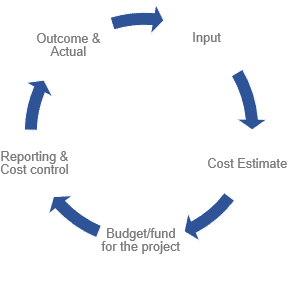
Cost estimating is an iterative process where the actual outcomes form the basis for improving future estimates. This iterative nature ensures that the cost estimating process continually evolves and becomes more accurate over time, as shown in Figure 6 below.
Figure 6 – Cost Estimate Process Cycle
By adhering to these principles, businesses can maintain financial stability and make informed decisions that support their growth and success.
Building a Predictable and Robust Reinstatement Process for Insurance Claims
Accurate cost estimation in the insurance market requires a structured approach that ensures transparency and consistency from concept to detailed stages. Each incident is assessed based on severity, complexity, and documentation quality to select the right methodology. Whether this is a Rough Order of Magnitude estimate using analogues, high-level reinstatement and upgrade assessments, or a detailed unit-cost and bill-of-quantity analysis. Supporting measures include benchmarking and validating third-party figures, correcting EPC estimates, adding contingencies, and conducting quality checks to confirm realism.
By integrating timelines, capturing engineering inputs, coordinating with vendors and contractors, and ensuring insurers allocate appropriate funds for future claims, this process creates a reliable, “no-surprise” environment throughout the claim’s reinstatement cycle.
References
- AACE: Association for the Advancement of Cost Engineering. AACE is a community of professionals from various practice areas including project controls, cost & commercial management, change management, planning & scheduling, estimating, decision & risk management, asset management, and dispute resolution. Members include owners, contractors, and consultants from many industries, such as construction, manufacturing, engineering, infrastructure, natural resources, power generation & utilities, and government. ↩︎
About the Author
Pietro is a Cost Estimating Director with 18 years of experience supporting major oil & gas and energy projects. He specialises in cost estimating, budgeting, cost control, project planning, risk assessment, and benchmarking. Pietro leads full lifecycle cost development, including CAPEX, OPEX, and ABEX, for a wide range of assets, including upstream facilities, petrochemical and refinery plants, pipelines, LNG terminals, power generation, subsea systems, and energy transition projects, including CCS and hydrogen.

Pietro Barone, MM (Eng), BM (Eng)
Director, Cost Estimating
+44 77 9916 9489
[email protected]
View Expert Profile