

Lessons learned from the Rimkus NEC4 Seminar at BCA Campus, Singapore
On 30 July 2026, Rimkus had the opportunity to conduct an NEC4 seminar at BCA Campus in Singapore, bringing together industry professionals to discuss a question that remains remarkably relevant across the construction and project-management sector.
Why do projects still experience delays, disputes and cost overruns despite the availability of sophisticated contracts, project-management systems and established industry practices?
To explore this question, Rimkus invited participants to share their views through an interactive word-cloud poll. The response was striking. Rather than identifying a single cause, participants highlighted a combination of issues including design changes, complexity, poorly drafted contracts, miscommunication, lack of clarity, unrealistic client requirements, planning issues, misalignment, poor management, unforeseen circumstances and inadequate collaboration.
The word cloud below captures the audience’s responses and provides a useful snapshot of the challenges that practitioners continue to encounter on projects.
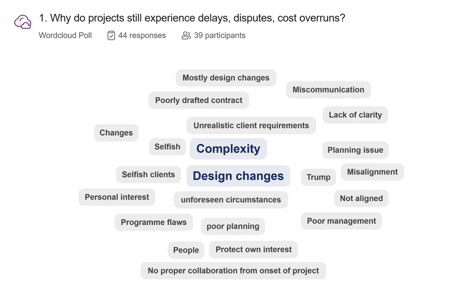
Figure 1: Audience responses to the question, “Why do projects still experience delays, disputes, cost overruns?” NEC4 Seminar, BCA Campus, 30 July 2026.
Interestingly, the feedback from our Singapore seminar is not unique to the local market. Similar themes emerge from construction research and industry surveys across Asia and internationally.
Design changes, poor communication and coordination, inadequate planning, contractual issues, delays and a lack of collaboration consistently feature among the causes of project disruption across different markets.
While the relative importance of each issue varies according to the country, project type and economic environment, the underlying challenges are remarkably consistent. This suggests that the issues raised by our seminar participants are not simply local concerns but reflect wider challenges facing the global construction industry.
The responses demonstrated an important reality: projects rarely fail because of one isolated problem. More often, delays, disputes and cost overruns are symptoms of multiple weaknesses interacting with one another.
Design changes and evolving requirements
One of the strongest themes emerging from the audience was design change. “Design changes” appeared prominently in the word cloud, alongside “changes”, “unrealistic client requirements” and “lack of clarity.”
Change is not inherently a problem. Construction projects inevitably evolve as better information becomes available, stakeholders refine their requirements, site conditions become clearer or unforeseen circumstances arise. The real difficulty occurs when changes are poorly defined, introduced too late, inadequately assessed or not communicated effectively to all parties.
Frequent design changes can disrupt procurement, sequencing, resources, programme and cost. They can also create disagreement over responsibility: Was the change foreseeable? Who caused it? Who should pay? What effect has it had on the programme?
This is precisely where the philosophy behind NEC4 becomes particularly relevant. NEC4 is designed around early communication, proactive management and dealing with change as it arises, rather than allowing issues to accumulate until they become claims or disputes. The contract cannot prevent a client from changing its requirements, but good contractual processes can help the parties understand the consequences of change and manage them before they escalate.
Complexity is not an excuse for poor management
Another prominent response was simply “Complexity.” Modern projects are becoming increasingly complex. They involve multiple disciplines, specialist contractors, sophisticated technologies, regulatory requirements, demanding programmes and numerous stakeholders. Complexity creates interfaces, and interfaces create opportunities for things to go wrong.
However, complexity itself does not necessarily cause disputes. Unmanaged complexity does. A complex project requires greater clarity about roles, responsibilities, information flows, decision-making and risk allocation. It also requires participants to recognise that problems at one interface can quickly affect other parts of the project.
This is where project management and contract management need to work together. A contract should not be treated merely as a document that is consulted when something goes wrong. It should provide a framework for managing the project day by day.
Communication and clarity remain fundamental
The audience also identified miscommunication, lack of clarity, misalignment and not being aligned as significant causes of project problems. These may appear to be simple issues, but they can have significant contractual and commercial consequences.
A project can have an excellent contract and still fail if the parties do not share a common understanding of what needs to be delivered, when it needs to be delivered, who is responsible for decisions and how emerging risks will be addressed.
Miscommunication can lead to assumptions. Assumptions can lead to different interpretations. Different interpretations can eventually become disputes. The lesson is straightforward: clarity must exist before conflict arises, not after.
NEC4’s emphasis on communication and early warning is therefore more than a procedural requirement. It reflects a broader philosophy of collaborative project management. Parties should communicate potential problems early enough to allow the team to consider solutions rather than waiting until positions become entrenched.
Planning problems create downstream consequences
The audience also mentioned poor planning, planning issues and programme flaws. A weak programme rarely remains a scheduling problem for long. Once activities begin to slip, the consequences can spread through procurement, resources, subcontracting, testing, commissioning and completion. A delay in one activity may affect several others, creating a chain reaction.
Effective planning therefore requires more than producing a programme at the beginning of the project. The programme must be actively managed and updated as circumstances change.
This is particularly important in an NEC4 environment, where programme management is closely connected with proactive management of the project. The programme should be a living management tool—not simply a document produced for contractual compliance.
Poorly drafted contracts and unrealistic requirements
“Poorly drafted contract” and “unrealistic client requirements” were also among the responses. A contract cannot compensate for fundamentally unclear requirements. Equally, even a well-structured standard form can create difficulties if it is poorly prepared, improperly amended or used without sufficient understanding of its mechanisms.
The audience feedback reinforces the importance of getting the foundations right. Before work begins, the parties should have a clear understanding of the scope, risks, responsibilities, programme, information requirements and decision-making processes.
If the employer’s requirements are unrealistic, or if the scope is insufficiently developed, the project may begin with problems already embedded in it. The contract should therefore be viewed as part of a wider project strategy. Good contracting starts before the contract is signed.
The human factor: collaboration versus self-interest
Perhaps the most interesting aspect of the poll was the number of responses relating to people and behaviour. Participants referred to “selfish clients,” “personal interest,” “protect own interest,” “people,” and, perhaps most significantly, “No proper collaboration from onset of project.”
This is an important observation. Construction contracts are ultimately implemented by people. No contractual mechanism can completely overcome adversarial behaviour, poor leadership or a lack of trust.
When project participants focus exclusively on protecting their own contractual position, information may be withheld, problems may be escalated unnecessarily and opportunities for practical solutions may be missed. A project can quickly become a competition between contractual positions rather than a collective effort to deliver the required outcome.
NEC4’s collaborative philosophy challenges this traditional mindset. The emphasis on early warnings, mutual communication and proactive management encourages the parties to identify problems collectively and consider how they can be resolved.
This does not mean that parties should abandon their legitimate commercial interests. Rather, it recognises that protecting one’s interests and managing the project collaboratively do not have to be contradictory objectives. In many cases, early collaboration is the best way for every party to protect its time, cost and commercial position.
Unforeseen circumstances will always exist
The response “unforeseen circumstances” is also important. No project can eliminate uncertainty. Ground conditions, supply-chain disruption, regulatory changes, weather, third-party issues and other unexpected events can affect even the best-planned project.
The objective of effective project management is therefore not to eliminate every risk. It is to ensure that when something unexpected occurs, the parties have a mechanism for identifying it quickly, assessing its consequences and responding appropriately. This is one of the fundamental lessons from the seminar: good contracts do not remove uncertainty; they provide a structured way of managing it.
Moving from reactive dispute resolution to proactive dispute avoidance
The responses from the BCA Campus audience ultimately point towards a broader conclusion. Delays, disputes and cost overruns are often discussed as if they are separate problems. In reality, they are frequently connected.
- Poor planning can lead to delay.
- Delay can create additional cost.
- Cost pressures can lead to disagreements.
- Poor communication can make those disagreements worse.
- Unclear responsibilities can turn a disagreement into a formal dispute.
And once relationships deteriorate, even relatively small issues can become difficult to resolve. The better approach is to intervene before the problem reaches that stage. This is where NEC4’s approach offers valuable lessons. Early warning, clear communication, effective programme management, compensation event processes and collaborative working are not merely contractual procedures. Properly understood and implemented, they are tools for creating better project behaviours.
Conclusion
The word cloud generated during our NEC4 seminar at BCA Campus in Singapore on 30 July 2026 provided valuable insight into how industry practitioners view the underlying causes of project delays, disputes and cost overruns. While the responses varied, several recurring themes emerged, including change, complexity, communication, planning, uncertainty and human behaviour.
These challenges demonstrate that project difficulties rarely arise from an inadequate contract alone. More often, they result from the way the project is planned, communicated and managed throughout its lifecycle. A well-drafted contract provides an important foundation, but it must be supported by clear requirements, realistic planning, effective communication, disciplined programme management and a genuine commitment to collaboration.
One of the most telling responses from the audience was “No proper collaboration from onset of project.” This highlights an important lesson: collaboration should not begin only when problems arise. It needs to be embedded from the earliest stages of a project and maintained throughout procurement, contract award and project delivery. Early engagement and open communication can often prevent relatively manageable issues from developing into major disputes.
This is also where the principles behind NEC4 can make a real difference. NEC4 is not simply a contractual framework; it promotes a more proactive approach to identifying, communicating and managing risk and change. The real benefit comes when its processes are understood and actively used by the project team.
Rimkus can support this approach by bringing specialist expertise to projects at different stages of their lifecycle. Through project advisory, contract and claims management, delay analysis, quantum assessment and dispute resolution, Rimkus can help clients identify potential risks early, assess the impact of change and delay, strengthen project and contractual decision-making, and address emerging issues before they develop into costly and protracted disputes.
Ultimately, better project outcomes require a shift from reacting to problems towards anticipating and managing them early. When the right contractual processes are combined with effective project controls, informed decision-making and specialist advice, project teams are better positioned to manage uncertainty, minimise disputes and protect time and cost.
The objective is not simply to have the right contract, it is to make the contract work effectively for the project and the people delivering it. By adopting this more collaborative and proactive approach, the industry can improve its prospects of delivering projects on time, within budget and with stronger relationships that endure through to completion.
This article is intended to provide general information and insights into prevailing industry practices. It is not intended to constitute, and should not be relied upon as, legal, technical, or professional advice. The content does not replace consultation with a qualified expert or professional regarding the specific facts and circumstances of any particular matter.